Second-year Mechanical Engineering student with a passion for design, prototyping, and solving real-world problems through thoughtful engineering.
I'm currently pursuing a degree in Mechanical Engineering, driven by a deep curiosity about how things work and how they can be made better. Whether it's analysing stress in a structure or sketching up a prototype, I approach every challenge with precision and creativity.
Outside the lecture hall, I spend time in the student workshop, iterating on ideas and building functional models. I believe the best engineers learn as much with their hands as they do from textbooks.
I'm actively looking for internship opportunities and collaborative projects where I can apply my skills and grow as an engineer.
Technical Skills
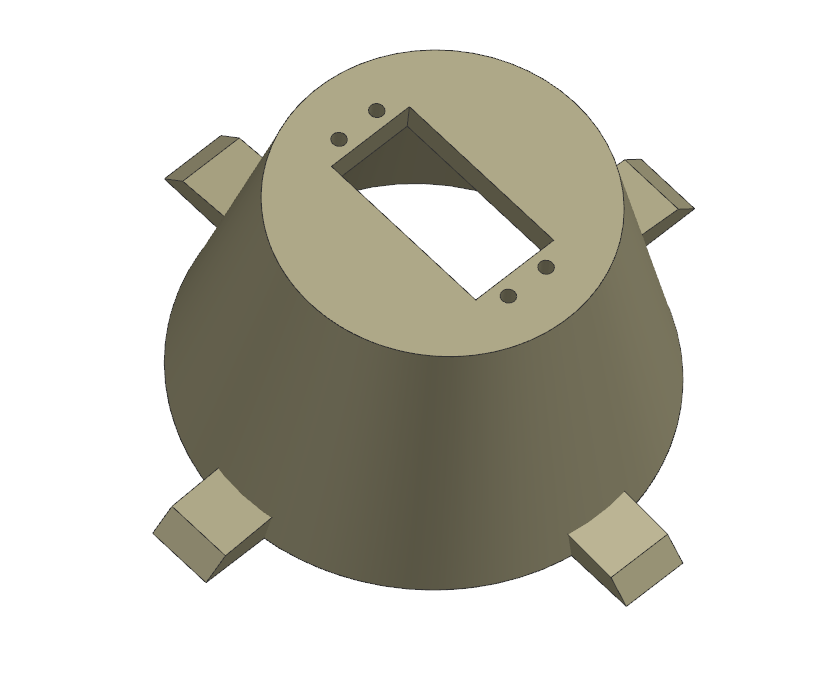
Designed a universal stem adapter in SolidWorks to fit two incompatible handlebar standards. Iterated through four prototypes using FDM printing, conducting basic load analysis to ensure structural integrity under cycling loads.
View Design Files ↗Performed static analysis on a Pratt truss bridge model using ANSYS. Compared analytical hand calculations to simulated results, identifying failure points under distributed loading and proposing cross-section reinforcements.
View Report ↗Built a MATLAB model to simulate counter-flow heat exchanger performance under varying flow rates and temperatures. Compared ε-NTU and LMTD methods, producing charts for design selection at different operating conditions.
View Code ↗A first-year design project applying DFM principles. Modelled in SolidWorks, manufactured using laser cutting and hand assembly. Focused on parametric design, allowing the model to be resized by changing a single variable.
View Drawings ↗Simulated damped pendulum dynamics in MATLAB, comparing small-angle approximations to full nonlinear solutions. Animated the motion and explored how drag coefficient affects energy dissipation over time.
View Simulation ↗Group project to design a two-finger pneumatic gripper for handling irregular objects. Contributed mechanical linkage design and GD&T drawings. The prototype achieved reliable grip across 5 different test geometries.
View Poster ↗I'm open to internships, part-time roles, and collaborative engineering projects. Feel free to reach out — I'd love to connect.
A universal stem adapter bridging two incompatible handlebar diameter standards, designed end-to-end in SolidWorks and validated through four iterative FDM prototypes.
The problem arose when a friend upgraded their handlebars but found the new 31.8 mm clamp incompatible with their existing 25.4 mm stem. Off-the-shelf shims existed but lacked adjustability and reliable clamping force distribution.
I modelled a two-piece adapter with an integrated split-clamp design, allowing the clamping torque to be evenly distributed around the bar. The geometry was fully parametric, so swapping between standard sizes required only a single dimension change.
Structural integrity under typical cycling loads (approx. 80 N handlebar pull force) was checked using SolidWorks Simulation with a basic static study. The fourth prototype passed a conservative 3× load factor without failure.
A full static analysis of a Pratt truss bridge model using ANSYS, cross-validated against hand calculations and used to identify failure points and propose reinforcements.
This project was completed as part of the Mechanics of Materials module. The brief was to model a Pratt truss under a distributed pedestrian load of 5 kN/m and evaluate stress distribution, nodal deflections, and likely failure modes.
I built the truss geometry in ANSYS Mechanical using beam elements, applied pinned-roller boundary conditions, and ran a linear static analysis. Results were then compared to analytical calculations done by hand using the method of sections.
The simulation and hand calculations agreed within 4% for all member forces — the discrepancy was traced to joint eccentricity in the FE model. Two lower chord members near mid-span were identified as critical; I proposed increasing their cross-section from 50×50 mm to 60×60 mm hollow section.
A MATLAB model simulating counter-flow heat exchanger performance, comparing the ε-NTU and LMTD design methods across a range of operating conditions.
Written for the Thermodynamics module, this model takes user-defined inlet temperatures, flow rates, and fluid properties, then calculates outlet temperatures and heat transfer rate using both the Log Mean Temperature Difference (LMTD) and effectiveness-NTU (ε-NTU) methods.
The script sweeps across a range of NTU values (0.1 to 5) and plots effectiveness curves for counter-flow and parallel-flow configurations on the same axes — making the performance advantage of counter-flow immediately visible.
A secondary parametric study varied the hot-side flow rate from 0.01 to 0.2 kg/s and tracked how outlet temperature and effectiveness changed, producing a surface plot useful for design selection.
A first-year design project applying Design for Manufacture principles, produced in SolidWorks and fabricated from laser-cut sheet material using a fully parametric model.
The brief was to design a functional desktop object that could be manufactured from flat sheet stock and assembled without adhesives or fasteners — relying only on press-fit joinery.
I chose a modular desk organiser with interlocking slot joints. The key design constraint was parametric control: every slot, tab, and panel dimension is driven by two master variables — material thickness and grid pitch — so the whole model updates correctly when either changes.
The final version was cut from 3 mm MDF on the university laser cutter. Assembly took under five minutes with no tools. A follow-up iteration explored 4 mm birch plywood, which improved rigidity noticeably.
A MATLAB simulation comparing small-angle and full nonlinear pendulum dynamics, with animated motion and a study of how drag coefficient affects energy dissipation.
This simulation was built as a self-directed extension of the Engineering Dynamics module. The goal was to explore where the small-angle approximation (sin θ ≈ θ) breaks down and how drag changes the system's behaviour.
Using MATLAB's ode45 solver, I integrated the full nonlinear equation of motion for a damped pendulum across a range of initial angles (5° to 60°) and drag coefficients. The results are plotted as phase portraits and time-series overlays between the linear and nonlinear models.
An animation was added using MATLAB's built-in animation loop, showing the pendulum bob in real time alongside the live energy plot. At initial angles above ~20°, the approximation error becomes clearly visible.
A group project to design a two-finger pneumatic gripper for handling irregular objects, achieving reliable grip across five test geometries through careful mechanical linkage design.
The team of four was tasked with designing a gripper capable of picking and placing objects of irregular geometry — a cylinder, a hex bolt, a foam cube, a PET bottle, and a flat disc. The constraint was a single-acting pneumatic actuator at 4 bar supply pressure.
My contribution was the mechanical linkage connecting the actuator piston to the two finger bodies. I designed a symmetric toggle mechanism that converts the linear actuator stroke into a parallel jaw motion, maintaining even grip force regardless of object width within a 15–60 mm range.
I also produced the full GD&T drawing set for the finger bodies and pivot pins, specifying tolerances to ensure consistent assembly and repeatable grip force. The prototype was machined from aluminium and assembled in the university workshop.